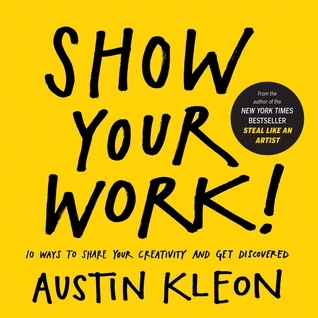
Show Your Work! by Austin Kleon (2014)


In the age of the "finished product" on Instagram and the "highlight reel" on LinkedIn, Austin Kleon’s Show Your Work! (2014) acts as a refreshing manifesto for the messy, the unfinished, and the authentic. As the middle child of his creative trilogy, this book shifts the focus from how to get ideas to how to let people find them.
The Trilogy: Where Does This Book Fit?
To understand Show Your Work!, you have to see where it sits in the series. Kleon has essentially built a "Creative Life Cycle":
- Steal Like an Artist: About finding inspiration and building your "genealogy" of influences.
- Show Your Work!: About the middle ground—sharing your process to find your "tribe."
- Keep Going: About staying creative in both good times and bad.
While Steal Like an Artist teaches you how to look at the world, Show Your Work! teaches you how to let the world look at you.
The 10 Principles of "Show Your Work!" (again)
1. You Don’t Have to Be a Genius
Stop waiting for a "masterpiece." Kleon argues that being an "amateur"—someone who does things for the love of it—is actually an advantage. Amateurs aren't afraid to make mistakes in public.
2. Think Process, Not Product
Document everything. Whether it’s a sketch, a failed attempt, or a photo of your desk, these are the "side effects" of your work that others find fascinating.
3. Share Something Small Every Day
Consistency beats virality. By sharing a "daily dispatch"—a tiny insight or progress update—you build a bridge to your audience one brick at a time.
4. Open Up Your Cabinet of Curiosities
Don't be a hoarder of information. Share your influences, the books you're reading, and the tools you use.
5. Tell Good Stories
People don’t just want to see what you made; they want to know why. Structure your work within a narrative of struggle and breakthrough.
6. Teach What You Know
The best way to learn is to teach. By sharing your "secrets," you don't lose your edge; you gain followers who respect your expertise.
7. Don’t Turn Into Human Spam
There is a fine line between sharing and shouting. Be a "node," not a "noise." Listen as much as you talk.
8. Learn to Take a Punch
When you put yourself out there, you will get criticized. Kleon teaches us how to filter the feedback: ignore the trolls, but listen to the peers who want you to get better.
9. Sell Out
"Sell out" is a dirty word for many, but Kleon argues that artists need to eat. Don't be afraid to charge for your work or keep a mailing list.
10. Stick Around
Don’t quit when things get quiet. Take a sabbatical if you must, but don’t stop. The only way to fail is to disappear.
Key Takeaways
- Document the Process: Don't wait for a masterpiece. Share your "trash," show your work-in-progress, and let the process be the scenery. Authenticity beats perfection every time.Teach & Curate: Generosity is a strategy. Use tutorials as self-promotion and share your "secrets." By being a fan of others and curating great work, you become a vital node in your community.Edit & Tell Stories: Use the "Overnight Test" to filter your posts. Wrap your work in a good story to make it relatable, but remember: Your work is not you. Don’t take the feedback personally.Play the Long Game: Creativity is a marathon, not a sprint. Prioritize financial sustainability and consistent sharing so you can keep creating for the long haul.
Final Rating: ⭐⭐⭐⭐ (4/5)
I have a real soft spot for how Austin Kleon presents his books. The square format, the handwritten typography, and the "blackout poetry" style illustrations make them feel like a personal notebook rather than a stiff business manual. They are incredibly easy to read—you can finish one in a single sitting—yet you’ll find yourself returning to them for years.
However, compared to the first book, I found this one slightly less "electric."
While Steal Like an Artist felt like a total paradigm shift in how I viewed creativity, Show Your Work! feels a bit more like a practical marketing manual. It is full of interesting ideas, but some of the advice on "sharing daily" feels a bit more challenging to implement in a world already saturated with social media noise.
Still, it’s a must-read for anyone who feels "stuck" in their studio or office and wants to start building a community.